4.3.2The Evidence Mounts

Fast Times: Parts Three & Four

4-117.

FAST TIMES, Part Three—The Evidence Mounts
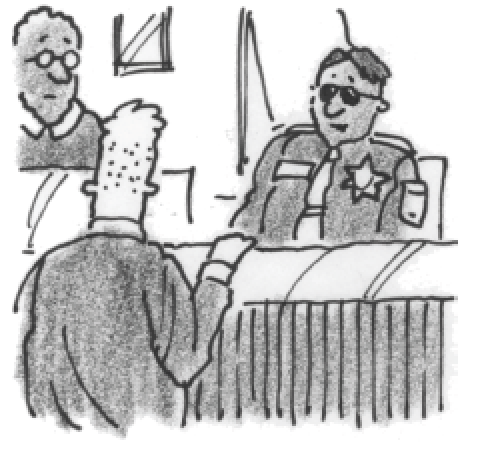
Prosecution: “As you have seen from the overwhelming evidence presented in our prior exhibits, we have irrefutable proof of the irresponsible driving behavior of the defendant. We must stop this callous behavior and make an example of this individual so that other teachers will realize they must abide by the rules of the road. I will now present the second infraction that occurred between D’exdete and Geprime. I would like to call Inspector Knoclew to the stand. Inspector, please inform us of the methods you used and the conclusions you reached.”

Inspector Knoclew: “Using cameras located at several key points along the highway between D’exdete and Geprime, we were able to determine the distance vs. time graph shown in Exhibit C below. Entering this critical information into our computer system, we have the following function which generates the graph in the exhibit.”

s(t)={291.67t3+1125t21360t+574.67for 1t<1.62500t312750t2+21600t12076 for 1.6t<1.8176t3+1142.4t22402t+1722.6 for 1.8t2.3

“From this data we found two sections of highway where the defendant was in excess of 70 miles per hour. In addition, we are also able to refute the defense’s average velocity argument used earlier since we know the defendant returned to Efofex after reaching Functionville.”

Your Task:

  1. How did the Inspector know that your teacher headed back to Efofex?

  2. What is the greatest speed in each section as defined in the piecewise-defined function? Use this information to verify or refute the inspector’s findings.

First quadrant, labeled Prosecution Exhibit C, x axis labeled time, hours, y axis labeled distance, miles, continuous curve starting at highlighted point, labeled D'exdete, in lower left corner, rising to highlighted point labeled, Functionville, falls to highlighted point Efofex, & rising & ending at highlighted point labeled Geprime.

4-118.

FAST TIMES, Part Four—The Rebuttal Witness

Things look bleak for your teacher and your class. The stress of the trial has already resulted in some difficult quizzes and you cannot help but notice the books of unsolved calculus problems that have been added to your instructor’s materials. Suddenly, one of your former teammates (clearly someone who is grateful for your past assistance) comes forward with some critical information. They state:

“I have investigated Exhibit B and Exhibit C and the evidence does not match. I suspect that the prosecution delivered both items separately so that you would not be aware of the problem.”

What is your teammate referring to? Investigate the evidence presented in Exhibits B and C. Write a convincing argument that will require Judge Ironhand to throw out this incriminating evidence. Make sure that you are accurate. Judge Ironhand loves to issue contempt citations for sloppy calculations!

First quadrant, labeled Prosecution exhibit B, x axis labeled time, hours, y axis labeled distance, miles, continuous curve starting at the origin,  passing through highlighted point labeled, Boundless, changing from concave up to concave down at highlighted point labeled, Calctown, ending at highlighted point labeled, D'exdete.First quadrant, labeled Prosecution Exhibit C, x axis labeled time, hours, y axis labeled distance, miles, continuous curve starting at highlighted point, labeled D'exdete, in lower left corner, rising to highlighted point labeled, Functionville, falls to highlighted point Efofex, & rising & ending at highlighted point labeled Geprime.

Exhibit B:     s(t)=93.75t3+93.75t2+45t

Exhibit C:    s(t)={291.67t3+1125t21360t+574.67for 1t<1.62500t312750t2+21600t12076 for 1.6t<1.8176t3+1142.4t22402t+1722.6 for 1.8t2.3

Review and Preview problems below

4-119.

Examine the following integrals. Consider the multiple tools available for evaluating integrals and use the best strategy for each part. Evaluate the definite integrals and state the strategies that you used. For the indefinite integrals, find the antiderivative function, if you can. Homework Help ✎

  1. (2y3)2dy

  2. 1223xdx

  3. sin(x2)dx

  4. 039x2dx

  5. (9m2+7m11)dm

4-120.

Calculate the area of the region in the second quadrant under the curve y=x3+2x23x. Homework Help ✎

4-121.

Write each of the following integral expressions as a single integral. Homework Help ✎

  1. 29(f(x))2dx29(g(x))2dx

  2. 35f(x)dx+59f(x)dx

  3. 21f(x)dx41f(x)dx+49f(x)dx

  4. 228k(x)dx+28j(x)dx

4-122.

Compare two different methods for determining a derivative in parts (a) and (b). Homework Help ✎

  1. Use the definition of the derivative as a limit to write the slope function, f, if f(x)=x2+3x+1.

  2. Use the Power Rule to write an equation for f. Do your answers agree?

  3. Use your slope function to calculate f(0) and f(1).

4-123.

Refer to the graph at right of y=f(x), the derivative of some function f. Homework Help ✎

  1. Where is f increasing? How can you tell?

  2. Approximate the interval over which f is concave up. Justify your conclusion with the graph.

  3. Is f(0) positive or negative? Explain how you know.

Continuous curve, starting in upper left, concave up, turning at the approximate points, (negative 2.5, comma negative 7), & (4, comma 5.5), passing through the x axis at negative 5, 1, & negative 6, changing concavity at (1, comma 0).

4-124.

A horizontal flag is shown below. 4-124 HW eTool Homework Help ✎

Horizontal segment, with shaded triangle above segment, with vertex on the segment 1 third from the right, triangle labeled as follows: top horizontal side, 8, right & left sides, each 5.

  1. Imagine rotating the flag about its pole and describe the resulting three-dimensional figure. Draw a picture of this figure on your paper.

  2. Calculate the volume of the rotated flag.

4-125.

Write and evaluate a Riemann sum to estimate the area under the curve g(x)=x·2x+2 for 4x0 using 20 rectangles. Then use your graphing calculator to compute the sum. 4-125 HW eTool  Homework Help ✎

4-126.

Let 35h(x)dx=4 and 35j(x)dx=2. Evaluate: Homework Help ✎

  1. 53(h(x)+j(x))dx

  2. 57(h(x2)+2)dx